Should your main katana page focus more on lifestyle or technical detail?
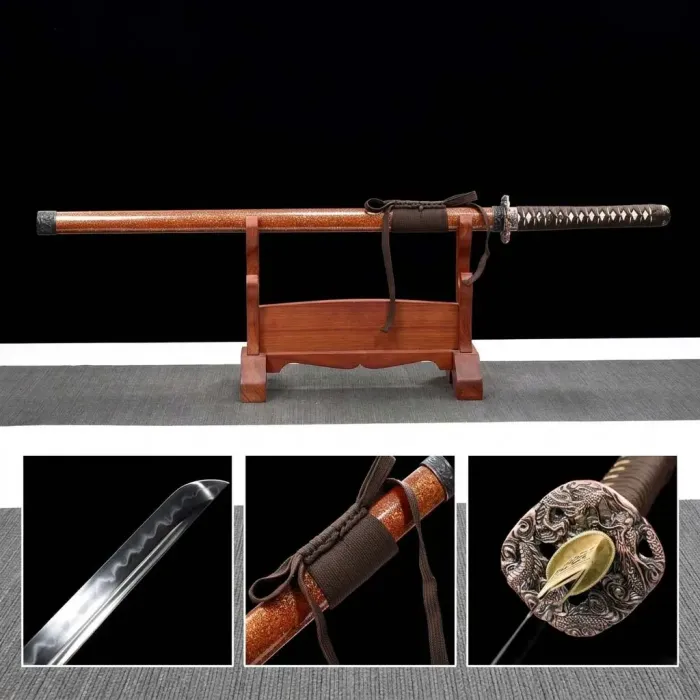
The customary oriental sword serves as a impressive display of technique, but what if you seek to exhibit your unique manner? Adapting your instrument is a deep journey, allowing you to construct a truly matchless piece. From the grip wrapping and fastening to the tsuba design and cutting motif, each segment offers a chance for distinctive style. This review delves into the realm of katana revisions, providing perspectives for both apprentices and accomplished enthusiasts hoping to create their signature on the heritage art of the samurai.
Newcomer's Original Mastery
For those prepared to embark on the satisfying journey of martial arts involving swords , 1060 steel katanas supply an remarkable entry point. This specialized grade of structural steel meets a golden mean between budget-friendliness and performance . While never as hard as upper-echelon steels, 1060 facilitates a fair level of knife work , making it suited for trainees to improve the fundamentals of katana upkeep and admire the charm of original Japanese weaponry. It’s a superb choice for fostering experience without the fiscal burden of more elite steels.
T Ten Alloy Sabers : Optimizing Functionality and Expense
Providing for connoisseurs seeking an authentic cutlass experience without overpowering the monetary limit , T10 material katanas represent a favorable option. These armaments offer a reasonable improvement in toughness compared to lower-grade alternatives, exhibiting decent edge retention and fair flexibility for initial hacking techniques. While not rivaling the excellent characteristics of elite steels like T100 or folded alloy , T10 provides a remarkable blend of power and budget-friendly nature , making them a sought-after choice for novices and those on a tight income .
Going past the Sharpness : Adapting Your Cutting Weapon's Fittings and Grasp
Though the refined edge is undeniably the essential point of a katana, truly improving its presence lies in the careful customization of its details and hilt . This process allows owners to reveal their personal approach . Reflect on the vast possibilities: menuki - decorative embellishments that add visual charm ; the hamon encasements – often exquisitely chiseled; the tsuka foundation itself, wrapped in customary ito twine ; and the fusa terminal , which can be crafted from various ingredients like precious metals or shell .
- Opt for ideas that align with you.
- Evaluate with diverse composites .
- Focus on robustness for a long-term result .
The Magnetism of the Katana: Background, Fabrication, and Iron
The samurai blade features a special allure, steeped in generations of Far Eastern history and custom . More than merely a device of hostilities , it's a representation of the fighter ethos – a fusion of ability and discipline . Its progression spanned countless generations, with early steel evolving into the polished curvature and precise edge we recognize today. The creation involved is truly amazing , requiring eons of apprenticeship to perfect . The process involves a detailed folding of wrought steel , creating layers that augment the sword’s flexibility and cleaving ability. Distinct schools of fabricating were established, each with their own secrets and methods for achieving the perfect stability and precision - a truly exacting pursuit.
- Former Katana styles
- The task of the katana in warrior culture
- Ancient metalworking techniques
Choosing the Perfect Steel for Your Cutting Tool Project: 1060 vs. T10
Picking the proper steel is fundamentally important for any armament project, and the option between 1060 and T10 can be complicated. 1060 is a prevalent American compound, offering a acceptable balance of toughness and robustness, providing it quite easy to temper. However, T10, a Japanese steel, generally boasts exceptional wear lastingness and can may achieve a superior definitive hardness, although it can be markedly challenging to process and requires accurate heat treatment. Consider your background and anticipated benefits: for a rookie, T10 steel katana 1060 may be a easier starting point, while the master smith might admire the supplementary attributes of T10.
- Ease of Utilizing
- Resistance
- Definitive Durability
Realizing the Capability: Sophisticated Katana Tuning Practices
Becoming proficient in blade modification extends far beyond basic whetting. Serious experts are now exploring advanced techniques to truly discover a blade's hidden potential. This requires intricate work with the hamon, utilizing specialized products for differential heat treating and carefully nominating the contour of the hand guard to optimize balance and functionality. Beyond purely functional changes, artisans are increasingly focused on achieving unparalleled aesthetic style, through complex engraving and layered films that truly transform a katana into a creation.
Turning Raw Material into Excellence: Creating a 1060 Katana
The journey embarks with typical 1060 substance, a resilient material far lacking the elegant katana it will develop into. Expert bladesmiths perform a involved process of overlaying and shaping the initial steel, repeatedly heating it and forging it to purify impurities and form a balanced grain structure. This laborious process, often persisting for cycles, builds the essential hardness and flexibility characteristic of a authentic Japanese cutlery . Further heat procedures , including deliberate hardening and tempering , are imperative to achieve the targeted equipoise of sharpness, longevity and attractiveness .- Integrating: Reduces impurities and forms grain structure.
- Crafting: Builds the steel into the initial blade form.
- Cooling: Sets the final hardness and flexibility.
The Durable Charm of the Katana: Intensive Inspection of Steel and Adaptation
The iconic katana persists a forceful symbol signifying Japanese style , its draw far extending beyond mere martial implements . Forged from distinctive steel and regularly featuring intricate decorations , the approach of creation itself is a venerated art. Beyond the central craftsmanship, the ability to refine a katana - from the hamon to the tsuka wrapping and habaki - enables for a genuinely individual embodiment for both admirers and wielders alike. This fusion of time-honored steelwork and boundless personalization results in the katana's continued fame across the planet .
